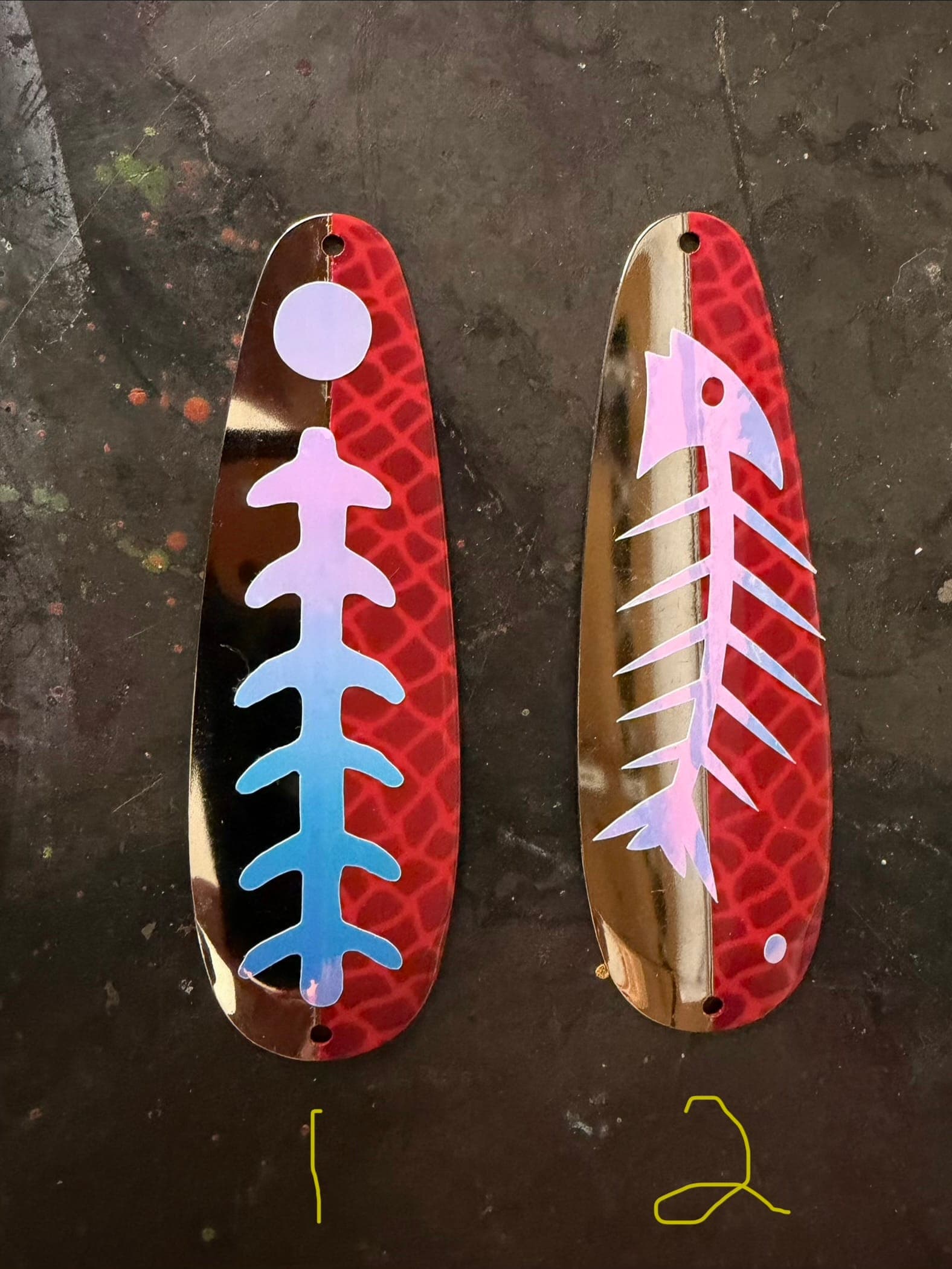
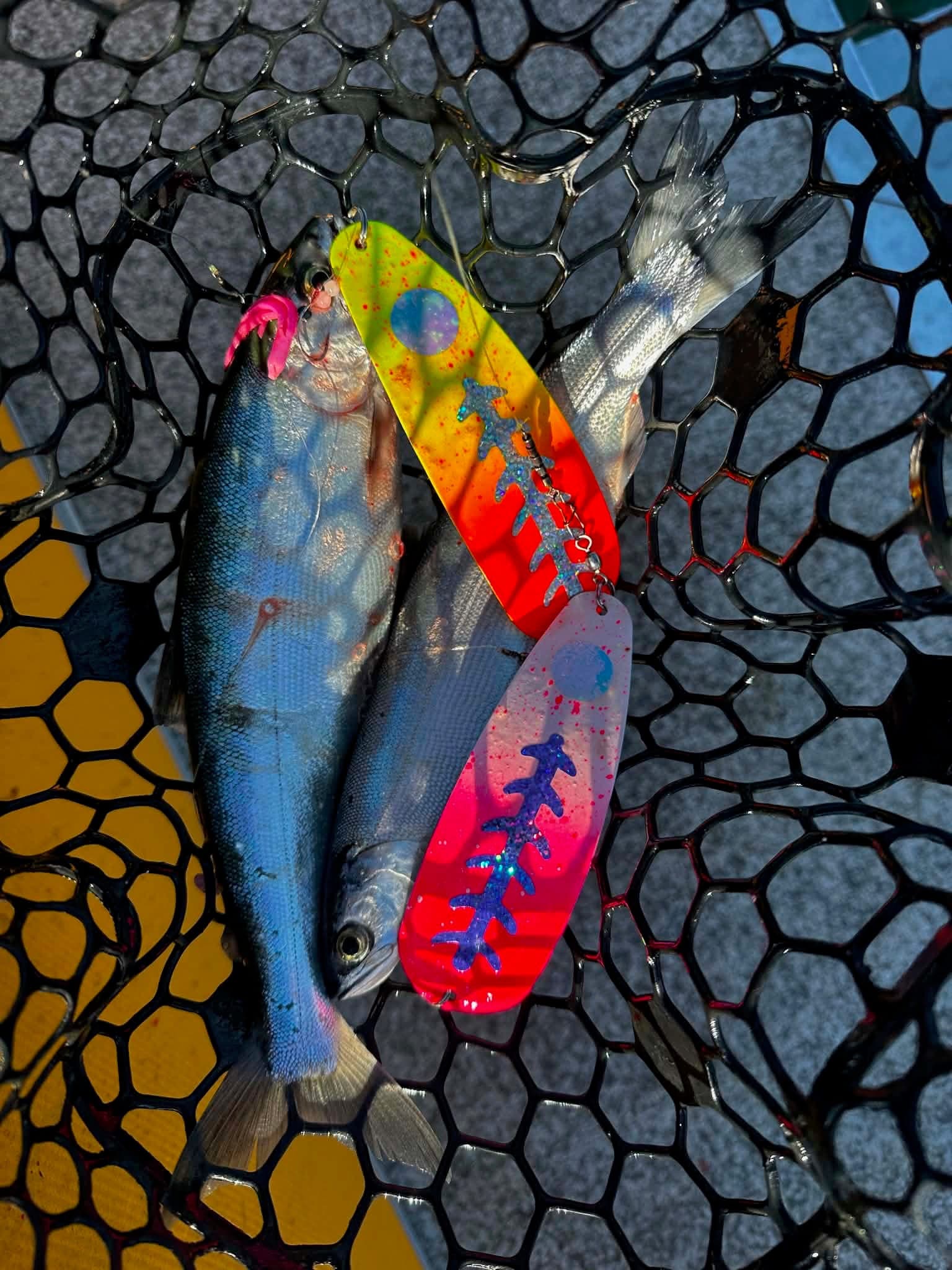
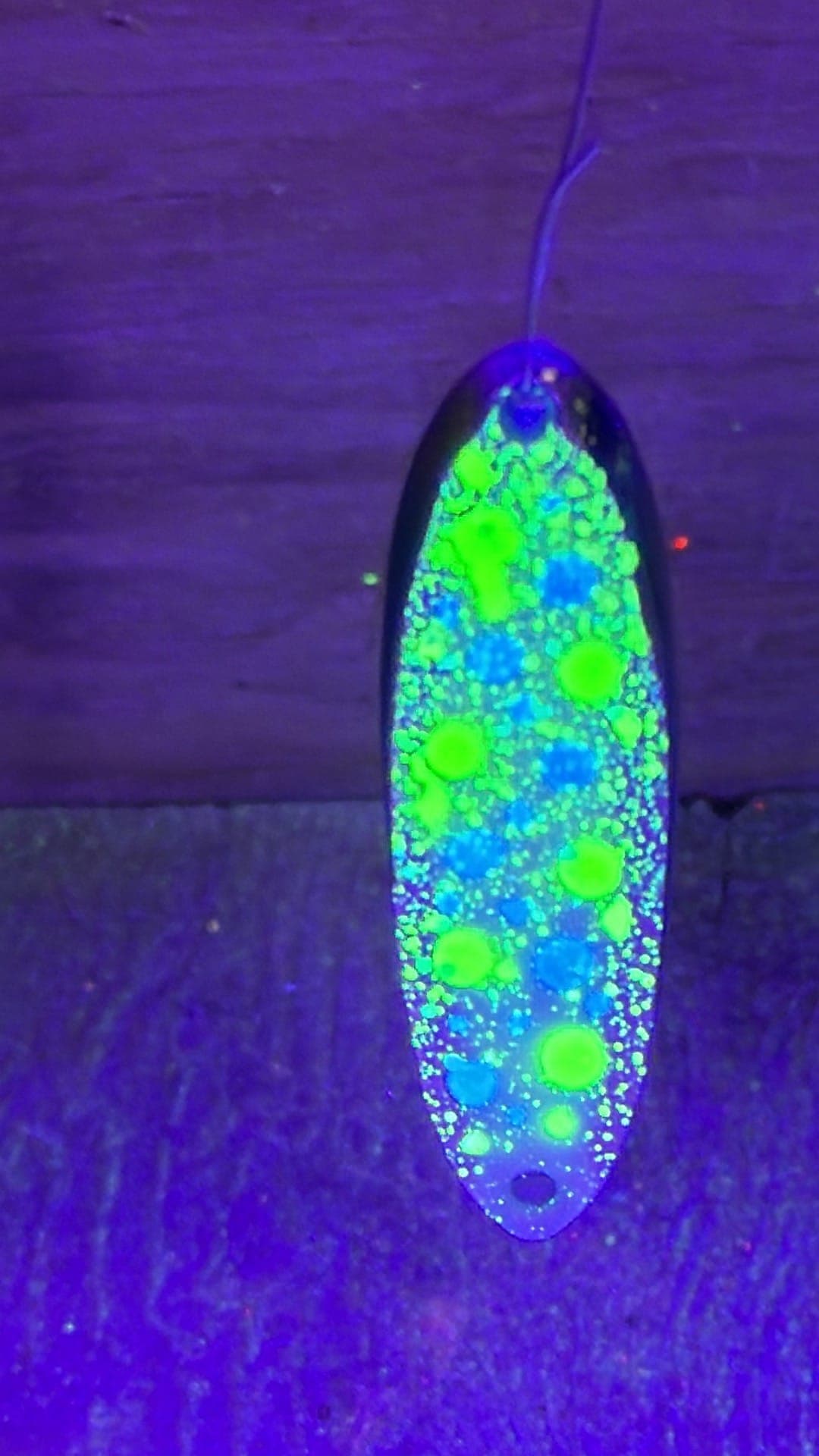
The shortest version: if your spoon's "glow" is a sticker applied to a foil or plastic body, you are running a piece of decoration that lasts thirty seconds in deep water and three trips of paint chip on the boat ride home. Phosphor-mix finishes are different — the glow is the paint, not a decal — and the difference shows up below 25 feet, when daylight gets blue-shifted out of the spectrum and the only thing salmonids can still see is the residual emission from a charged surface.
1. The physics, briefly
Phosphorescent pigments absorb high-energy photons (UV-A and short-wavelength visible blue) and re-emit them slowly as longer-wavelength visible green over a 5-30 minute decay. The most common pigment is strontium aluminate doped with europium — "SrAl₂O₄:Eu²⁺,Dy³⁺" if you want to look it up — and the green emission peak around 520 nm is exactly inside the visible window for salmonid retinas. That's the engineering: the lure stores the brightest part of sunlight (or a UV pen) and pays it back over the troll, in a color that fish can still see when humans can't.
Stickered "glow" finishes use the same pigment, just embedded in a clear adhesive film. The film is 30-80 microns thick, the pigment loading per area is a fraction of a paint coat, and the moment the edge of the sticker meets rock or fish, it lifts. The pigment also degrades when the film yellows in UV — which is ironic — so the stickered finish actually loses brightness over the same hours it took your paint-cured finish to charge up.
2. Why depth matters more than time of day
Every meter of fresh water absorbs about 0.18 log10 of red wavelengths and roughly 0.01 of blue-green. At 30 feet (10 meters), red is functionally gone, orange and yellow are nearly invisible, and what reaches your spoon is a narrow blue-green band — exactly the wavelengths that excite phosphorescent pigments AND the wavelengths salmonids' rod cells are tuned for. A bright red sticker at 40 feet is a gray blob. A green-emitting phosphor finish at 40 feet is the only thing in the water column putting out usable light.
This is also why dawn and dusk glow performance is overstated for shallow water. If you're fishing the top 15 feet, ambient light is doing most of the work and a stickered foil flashes fine. Below 25 feet — kokanee thermocline territory in summer, mackinaw structure-water, chinook-on-bait depth — the lure has to make its own light, and the surface coating that holds that capability decides the bite.
3. The UV-charge protocol that actually works
A handheld 365nm UV pen (available for under $25) charges a phosphor finish to peak emission in 8-12 seconds. Charge before each set, charge again between drops. The decay curve is biexponential — bright for 2-4 minutes, useful for 15-25 minutes, then below visual threshold. For a 90-minute troll set, a charge every 20-25 minutes maintains usable glow throughout.
Sun-charging works but it's less efficient. The phosphor absorbs UV-A best; window glass blocks most UV-A; cloudy days cut surface flux by ~70%. A pen is worth the box space. Keep it on a lanyard. Charge before you drop, every drop.
- • 365nm UV pen (not 395nm — the cheaper ones are too long-wavelength for peak excitation)
- • Charge for 10 seconds with the pen at 1-2 inches from the surface
- • Re-charge every 20-25 minutes during the troll
- • Pre-dawn / dusk: charge once 30 minutes before setting up — the residual emission is enough for the low-light window
- • Bright sun: still charge with the pen — sunlight surface charges but the pen penetrates the finish more uniformly
4. Color-by-depth, briefly
Phosphor emissions come in several flavors — green (520nm) is the standard, yellow-green (540nm) and blue (490nm) are the alternates. For salmonids in stained Western reservoir water, the green pigment is the workhorse. Blue emissions read better in clear cold water (Tahoe, Pend Oreille thermocline) where the entire ambient is already blue-shifted. Yellow-green outperforms in dawn/dusk where ambient orange is still around to layer with.
5. Why ceramic clear-coat matters
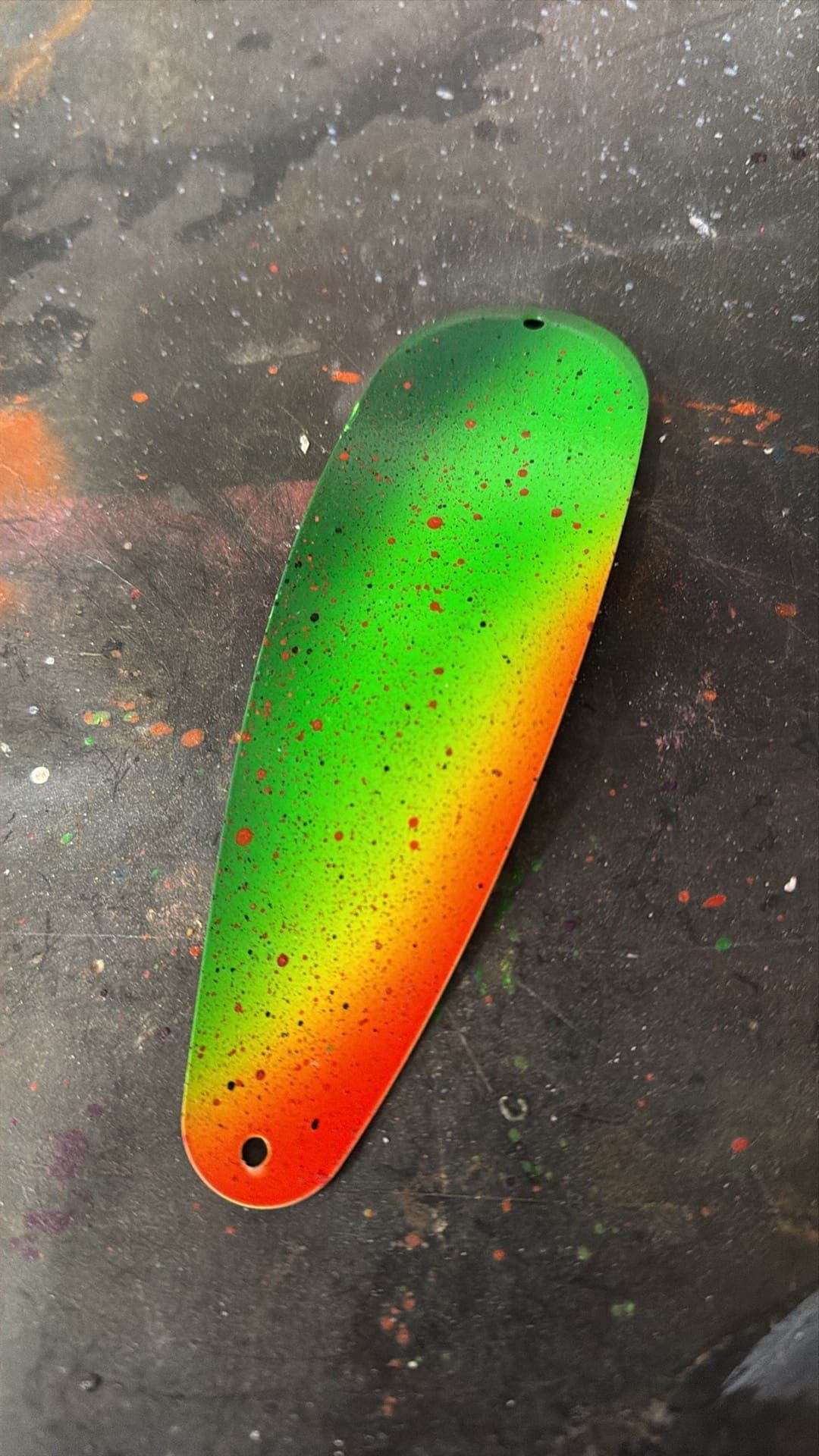
The phosphor pigment is suspended in an acrylic or epoxy binder. Bare binder is soft and scuffs in 2-3 trips. A ceramic-loaded clear coat protects the finish from rock hits, tooth chip, and the abrasion of the dodger's clevis chain — without filtering the UV input or absorbing the emission. Every Duskcraft spoon ships with a finished ceramic clear over the phosphor base. That's why "hand-built" matters: spray-on automated finishes can't hit the right thickness without trapping bubbles, and bubbles diffuse the emission.
6. The shorter answer for the next bait-shop conversation
If somebody asks you why a $24 Duskcraft spoon catches more than a $9 Mack's under the same dodger at the same depth, it's not magic. It's engineering: the glow is in the paint, not in a sticker. The paint is loaded with the right pigment at the right concentration. The clear coat protects it. The lure makes its own light at 40 feet when nothing else in the water column can. The fish sees it. Sticker spoons hope. Phosphor spoons engineer.